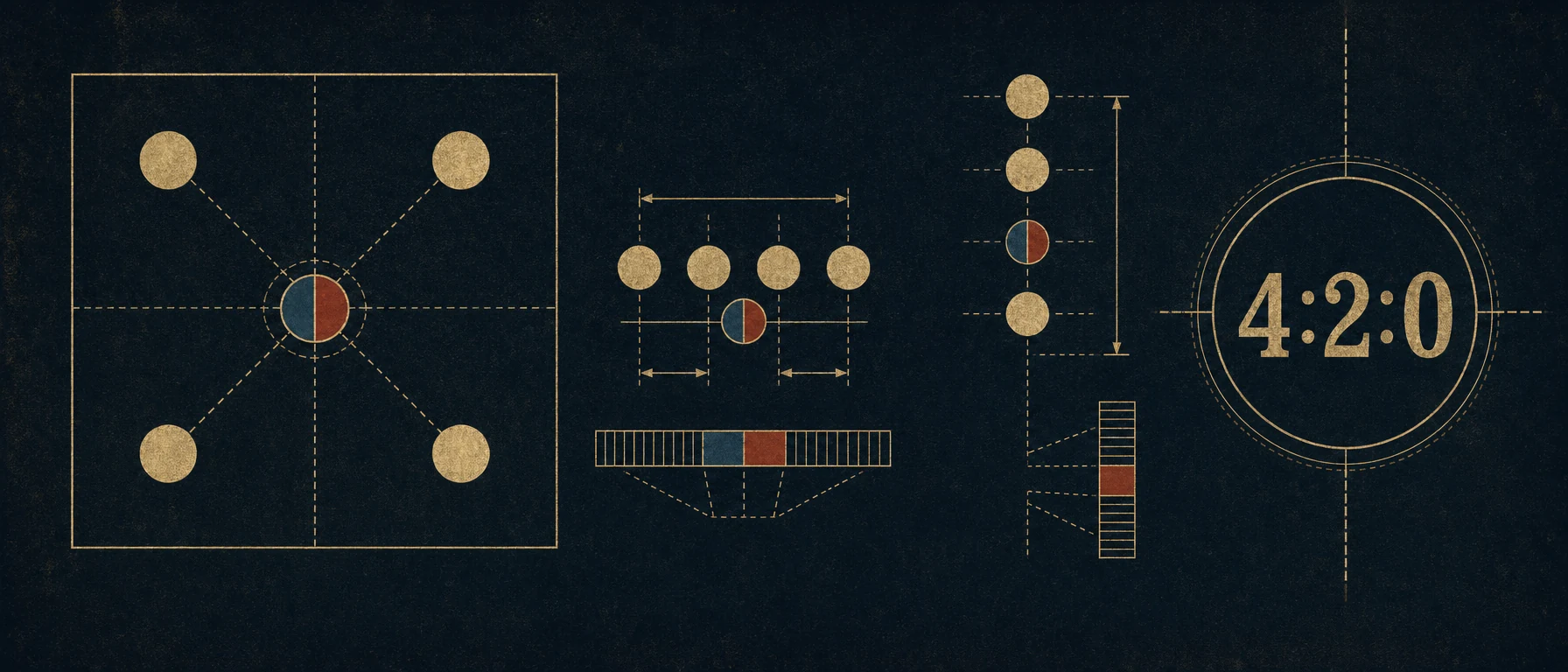
4:2:0 chroma subsampling reduces both horizontal and vertical chrominance resolution by 50%. This is the standard for consumer streaming, broadcasting, and offers optimal compression efficiency with minimal perceived quality loss.
4:2:0 Chroma Subsampling (Consumer/Streaming Standard)
4:2:0 represents the consumer and streaming standard for chroma subsampling, reducing both horizontal and vertical chrominance resolution by 50%. This ratio maximizes compression efficiency while maintaining acceptable quality for consumer viewing, and is the de facto standard for all consumer video delivery.
Technical Specification
4:2:0 defines aggressive color reduction:
Sampling Arrangement:
- Luminance (Y): Full resolution horizontal and vertical
- Chrominance (Cb): Half horizontal, half vertical resolution
- Chrominance (Cr): Half horizontal, half vertical resolution
- Pattern: For every 4 luminance samples (2x2), 1 Cb and 1 Cr sample
Notation Explanation:
- First "4": Luminance sampling rate (baseline)
- "2" (second): Chrominance horizontal at 50% of luminance
- "0" (third): Chrominance vertical at 50% of luminance (not 0, confusing notation)
Compression Efficiency
4:2:0 achieves maximum compression:
Data Reduction:
- Uncompressed: 1 byte per 2x2 pixel block = 75% data reduction
- Effective bitrate: 50% of 4:4:4 RGB equivalent
- Practical result: Excellent compression without visible artifacts
Bitrate Examples (1080p/24fps):
- Uncompressed 4:2:0: ~41 Mbps
- H.264 4:2:0: 5-8 Mbps (near-lossless)
- YouTube 4:2:0: 2-4 Mbps (high quality streaming)
Perceptual Quality
Why 4:2:0 Works Visually:
- Human eye severely limited at detecting color detail
- Color vision concentrated in central retina
- Peripheral vision primarily luminance-sensitive
- 4:2:0 color loss imperceptible to human eye
Practical Viewing:
- Indistinguishable from 4:2:2 at normal viewing distance
- Significantly better than 4:2:0 + heavy chroma compression
- Adequate for all consumer viewing conditions
- Professional monitors can't discern 4:2:0 vs 4:2:2
Industry Standards Using 4:2:0
Streaming Platforms:
- Netflix (all resolutions)
- YouTube (standard delivery)
- Amazon Prime Video
- Disney+, Apple TV+, Hulu
- Vimeo and other platforms
Broadcast Television:
- HDTV broadcast (uses H.264 4:2:0)
- Satellite television
- Cable television
- Terrestrial digital television
Consumer Media:
- Blu-ray video
- Digital television
- Mobile video
- Consumer camcorders
Internet Video:
- Video streaming services
- Social media video (YouTube, TikTok, etc.)
- Video conferencing (Zoom, Teams)
- User-generated content platforms
4:2:0 Codec Examples
H.264/AVC:
- Universal codec supporting 4:2:0
- Netflix primary delivery format
- YouTube standard format
- Broadcasting worldwide
H.265/HEVC:
- Modern efficient 4:2:0 codec
- Netflix 4K streaming
- Broadcast HDR alternative
- Growing adoption
VP9/AV1:
- Open-source alternatives
- YouTube support
- Better compression than H.264
- Emerging standard
Production to Streaming Pipeline
Color Format Degradation Path:
- Acquisition: 4:2:2 or 4:2:0 (professional or streaming)
- Editing/Grading: 4:2:2 or higher for color work
- Master Generation: 4:2:2 professional master created
- Encoding: 4:2:0 H.264/H.265 for streaming
- Delivery: 4:2:0 consumed by viewer
Workflow Consideration:
- Color grading requires 4:2:2 or higher
- Grading creates 4:2:2 master
- Streaming encode converts to 4:2:0
- No re-grading possible from 4:2:0
Practical Limitations of 4:2:0
When Artifacts Become Visible:
- Extreme color saturation in small areas
- High-frequency color patterns (impossible to test in practice)
- Very large screens viewed closely
- Specialized test patterns
Real-World Content:
- Artifact-free for virtually all natural content
- Professional color work indistinguishable at viewing distance
- Fine color detail preserved adequately
- Perceptually lossless for all practical purposes
Comparison with Adjacent Standards
| Ratio | Chroma Horiz | Chroma Vert | Bitrate | Quality | Use |
|---|---|---|---|---|---|
| 4:2:2 | 50% | 100% | ~2x 4:2:0 | Professional | Broadcast |
| 4:2:0 | 50% | 50% | Baseline | Consumer | Streaming |
| 4:2:0 (heavy) | 50% | 50% | Low | Compromised | Budget streaming |
On-Set Monitoring in 4:2:0
Practical Considerations:
- 4:2:0 rarely used for on-set acquisition
- Professional workflows avoid 4:2:0 for shooting
- Streaming deliverables specify 4:2:0
- Grading from 4:2:0 source not recommended
Monitoring Limitations:
- 4:2:0 sufficient for basic focus and exposure
- Color work requires 4:2:2 or higher source
- Streaming review in 4:2:0 acceptable
- Professional verification requires higher quality
Why 4:2:0 Dominates Consumer
Technical Advantages:
- Maximum compression efficiency
- Imperceptible quality loss for viewers
- Universal hardware support
- Proven long-term stability
Economic Advantages:
- Smallest practical file sizes
- Lowest bandwidth requirements
- Fastest streaming delivery
- Cheapest distribution costs
Viewer Perspective:
- No visible quality difference from higher ratios
- Perfectly adequate for all viewing conditions
- Compatible with all consumer devices
- Comfortable streaming bitrates
4:2:0 HDR Streaming
Emerging HDR Delivery:
- 4:2:0 with PQ/HLG transfer functions
- Streaming platforms experiment with HDR
- Works surprisingly well
- Bitrates remain manageable
Practical HDR Streaming:
- Netflix HDR uses H.265 4:2:0
- Apple TV+ explores HDR streaming
- Bitrate challenges with HDR
- 4:2:0 makes HDR streaming economical
Professional Workflow Philosophy
Standard Acquisition to Delivery:
- Shoot 4:2:2 or better
- Grade in 4:2:2 or better
- Master in 4:2:2
- Deliver 4:2:0 to consumers
- Archive preserves 4:2:2 master
Why Not Shoot 4:2:0:
- Limits color grading flexibility
- Reduces future delivery options
- Risks color artifacts during correction
- Creates quality ceiling
Future of 4:2:0
4:2:0 will remain standard because:
- Proven Technology: Decades of successful use
- Device Ubiquity: Every device plays 4:2:0
- Economics: Most efficient compression
- Perceptual Parity: Indistinguishable from higher ratios
- Bandwidth Reality: Practical necessity for streaming
4:2:0 represents the equilibrium between streaming economics and human perception, unlikely to change despite technological advancement.