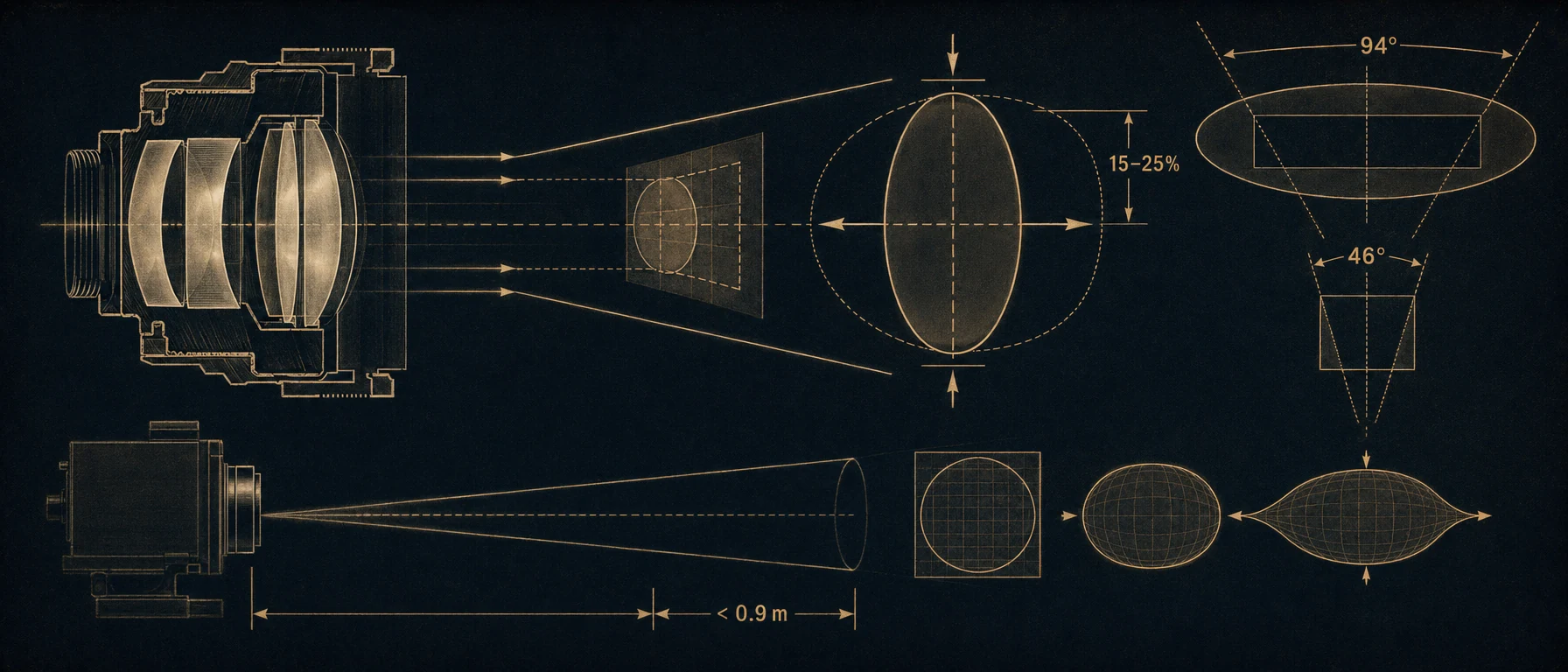
Optical aberration in anamorphic lenses causing lateral chromatic distortion and color fringing at image edges.
Technical Details
The distortion arises from the asymmetrical construction of anamorphic lenses, which achieve horizontal fields of view of 94° at an effective focal length of 25mm, while only capturing 46° vertically. At shooting distances below 0.9 meters, the effect intensifies exponentially – facial width appears to be enlarged by 15-25%, while facial length is proportionally compressed. The distortion is particularly pronounced in Panavision Ultra Vista Lenses 1.65x and Cooke Anamorphic/i 2x systems.
History & Development
The term became established in the 1960s on the set of "Lawrence of Arabia" (1962), when cinematographer Freddie Young first documented facial distortions with Panavision lenses. In 1967, Joe Dunton at Samuelson Film Services developed the first correction charts for optimal actor positioning. In the 1980s, cinematographers like Vilmos Zsigmond conducted systematic studies for minimization, while modern digital de-squeeze algorithms have enabled post-production corrections since 2010.
Practical Application in Film
Ridley Scott deliberately used the distortion in "Blade Runner" (1982) for close-ups of replicants to enhance their artificiality. Paul Thomas Anderson consistently avoids it in "There Will Be Blood" (2007) by maintaining minimum distances of 1.8 meters for dialogue scenes. Christopher Nolan uses the 65mm Panavision System 65 in "Dunkirk" (2017) to intentionally utilize the distortion in cockpit shots for claustrophobia effects. The standard workflow requires focus puller training for precise distance measurement and actor briefings on optimal head positioning.
Comparison & Alternatives
Unlike spherical lenses, which produce symmetrical barrel distortion, anamorphic optics distort exclusively horizontally. Modern ARRI Master Anamorphic series reduce distortion by 60% compared to vintage Panavision glass. Digital Intermediate allows for selective facial corrections, while hybrid workflows with 1.33x squeeze factors minimize the effect. Spherical shots with subsequent cropping offer a distortion-free alternative with an identical aspect ratio of 2.39:1.