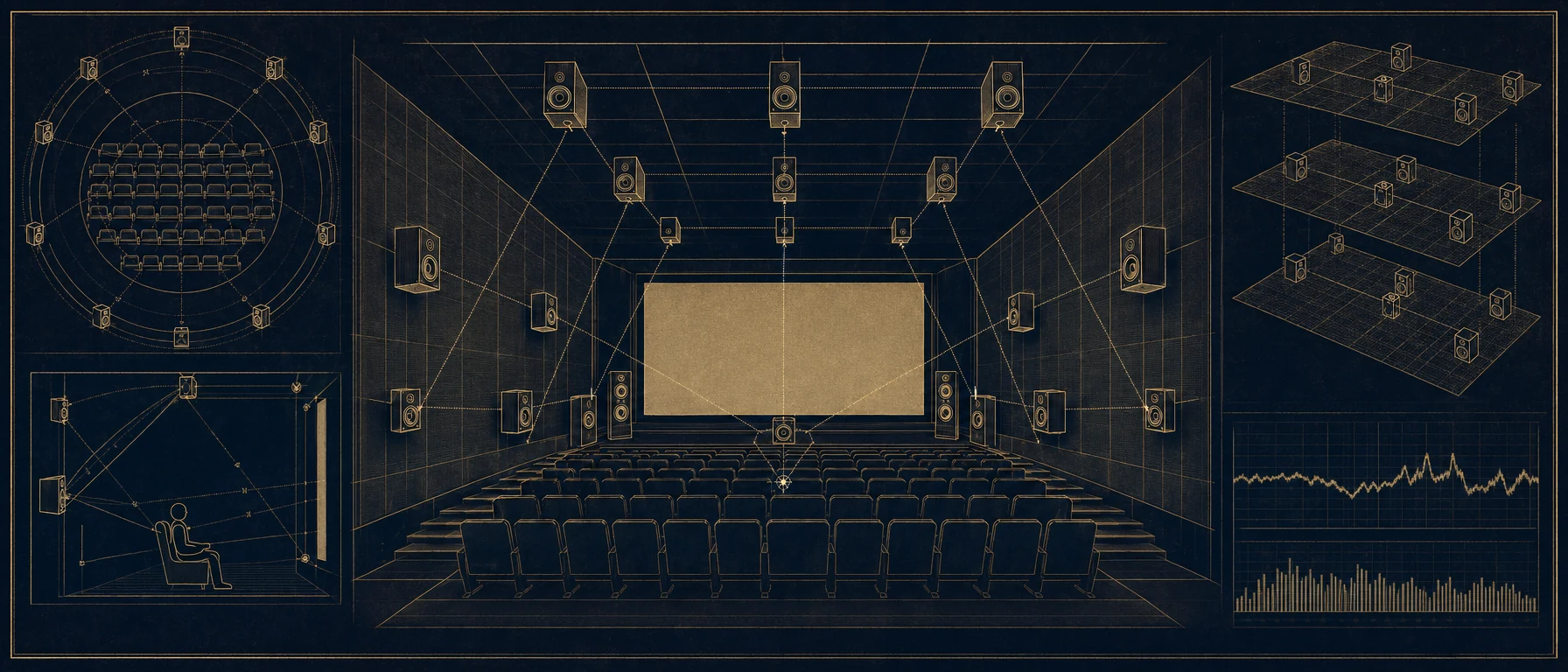
Object-based surround audio format featuring height channels for immersive theatrical sound reproduction.
Technical Details
The standard configuration comprises 11.1 channels: 5 lower speakers (L, C, R, Ls, Rs), 4 height speakers at a height of 9.5 meters on the side walls, 2 top speakers on the ceiling, plus a subwoofer. Extended setups reach 13.1 with additional rear-height speakers. The AuroCodec compresses audio data with lossless 48kHz/24bit quality and utilizes downward compatibility for 5.1 systems. The decoders operate with 32-bit floating-point processing and a latency under 10 milliseconds.
History & Development
Auro-3D was developed between 2005-2010 by Wilfried Van Baelen at the Belgian company Galaxy Studios/Auro Technologies. The first commercial installation took place in 2012 at Kinepolis Antwerp. In 2013, the first Auro-3D film "Red Tails" followed in a re-recording, while "The Amazing Spider-Man 2" (2014) was the first to be natively produced in Auro-3D. Barco integrated Auro-3D technology into its digital cinema projectors in 2014. By 2020, over 800 Auro-3D cinemas had been installed worldwide, primarily in Europe and Asia.
Practical Application in Film
Productions like "Fantastic Beasts and Where to Find Them" (2016) and "Blade Runner 2049" (2017) utilized Auro-3D for atmospheric soundscapes, where rain or city noises are distributed across the height layers. The Voice-of-God layer is suitable for helicopter sounds, thunderclaps, or mystical voices. The workflow requires special monitoring setups in mixing studios and separate stems for each layer. Lower adoption compared to competitors complicates distribution but offers cost-effective retrofitting of existing cinemas.
Comparison & Alternatives
In contrast to Dolby Atmos' object-based approach, Auro-3D works channel-based with fixed speaker positions. DTS:X combines both approaches, while IMAX Enhanced targets consumer hardware. Auro-3D requires fewer speakers than Atmos (11.1 vs. up to 64 objects) and enables more affordable installations. For smaller cinemas or retrofits, Auro-3D offers practical advantages, while Atmos dominates premium cinemas and Hollywood productions. AuroMax can upmix existing 5.1 material, increasing program diversity.