Bumper is an audio element used in professional sound production.
Technical Details
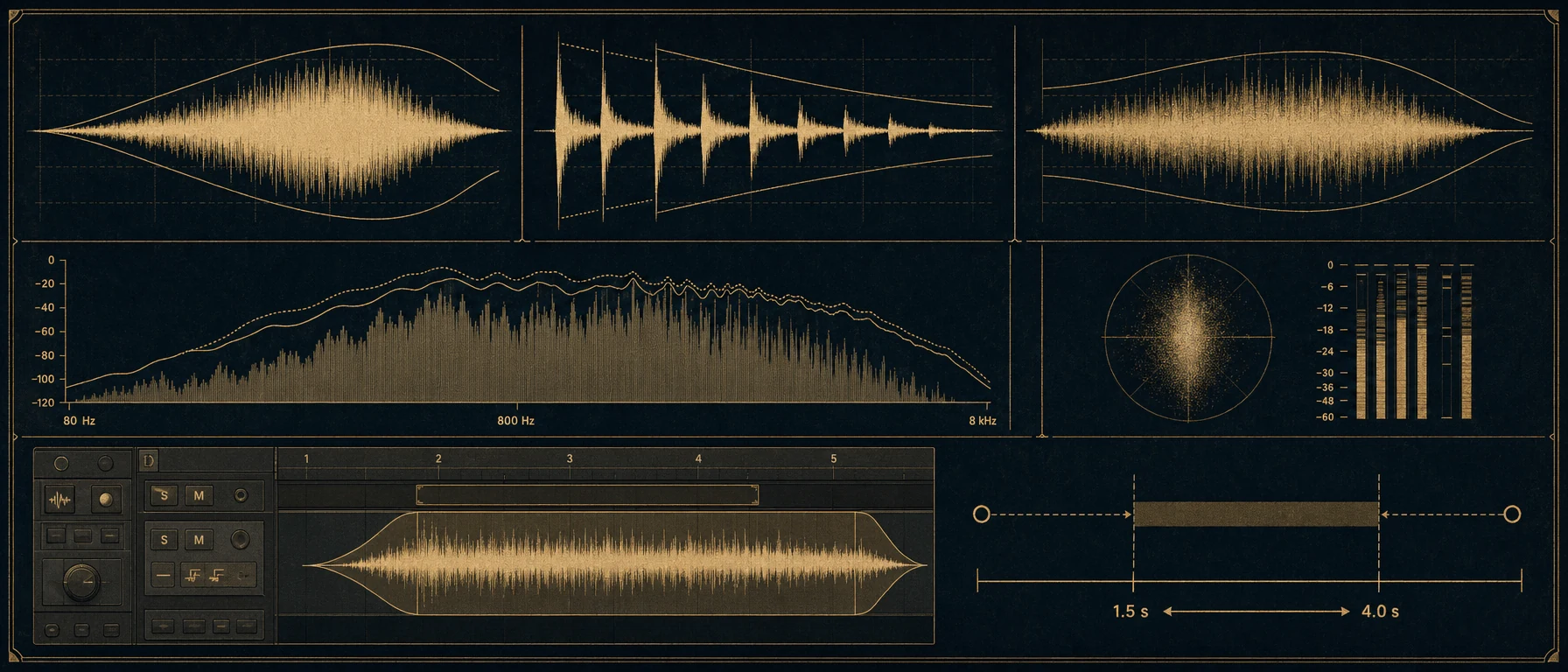
Bumpers are recorded by default at 48 kHz/24-bit and have an average length of 1.5 to 4 seconds. They usually consist of a combination of musical elements, sound effects, or ambient tones. In digital post-production, they are inserted as separate audio tracks in ProTools, Nuendo, or Logic Pro. Three main variants exist: Music Bumpers (melodic fragments), Percussion Bumpers (rhythmic accents), and Ambience Bumpers (room tone-based). The frequency distribution is typically between 80 Hz and 8 kHz to avoid conflicts with dialogue (300-3,400 Hz).
History & Development
The first documented use of bumpers in film occurred in 1952 in Hitchcock's "Vertigo," where composer Bernard Herrmann composed short orchestral accents as scene transitions. In the 1970s, the technique became established through blockbusters like "Jaws" (1975) and "Star Wars" (1977). Digitization in the 1990s enabled more precise placement and editing. Today, bumpers are generated and manipulated in real-time using software like Native Instruments Kontakt or Spectrasonics Omnisphere.
Practical Use in Film
In "Inception" (2010), Hans Zimmer used 2.3-second bumpers based on Édith Piaf's "Non, je ne regrette rien" for dream level transitions. In action films, bumpers are often used at lengths of 0.8-1.2 seconds to support rapid cutting sequences. The workflow typically occurs during the final sound mix: sound designers create a bumper library with 20-50 variants, which the re-recording mixer uses situationally. Marvel productions use standardized bumper templates with pre-made EQ curves for consistency across different films.
Comparison & Alternatives
Bumpers differ from stingers in their transitional function rather than punctual accentuation. Unlike bridges (5-15 seconds), bumpers remain under 4 seconds. Modern alternatives include whooshes (wind-based transitions) and risers (ascending tonal elements). For low-budget productions, free bumper libraries from Freesound.org are often used, while high-end productions commission custom bumpers from composers. The choice depends on genre and target audience: horror favors dissonant bumpers, while comedies rely on harmonic variants.