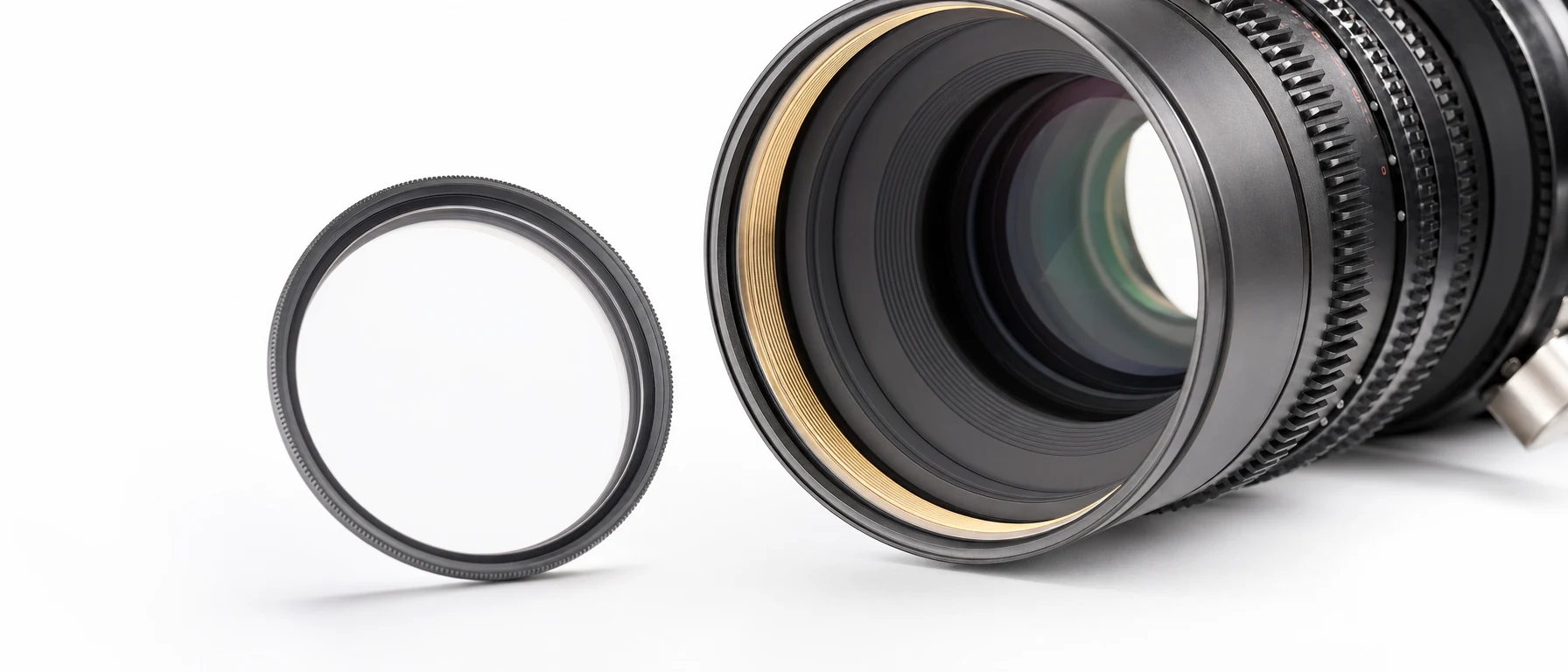
Optically neutral protection filter that shields the front element from dust, scratches, and moisture without affecting image quality.
Technical Details
Clear filters are manufactured from ground borosilicate glass or optical crown glass with a thickness of 1-3mm. The surfaces receive a multi-layer coating (multi-coating) with 8-16 layers, which reduces reflections to below 0.5%. Standard threads comply with M39, M42 standards or modern bayonet systems. High-quality versions achieve a flatness of λ/4 (lambda quarter) and show no color shift in the spectral range of 400-700nm. For digital cinema cameras, IR/UV-cut clear filters with specific blocking characteristics below 380nm and above 780nm are used.
History & Development
The first commercial clear glass protection filter was introduced in 1952 by the Japanese company Nikon for their 35mm format lenses. Panavision adapted the concept in 1958 for their anamorphic lenses and made protection filters standard in film production. The development of modern coating techniques by Carl Zeiss (1963) and later by Schott Glass (1971) enabled transmission-optimized filters. With the advent of digital cinema cameras from 2005 onwards, specialized IR-cut clear filters emerged, blocking unwanted infrared radiation.
Practical Use in Film
During exterior shots, clear glass protects against dust, saltwater, and mechanical damage to the front lens element. Camera crews routinely use clear filters for action sequences, pyrotechnic scenes, or in dusty environments such as desert shoots. Roger Deakins consistently used Schneider-Kreuznach clear filters on "Blade Runner 2049" (2017) to protect the sensitive Panavision lenses from practical effects. Filter changes take 10-15 seconds, allowing for quick cleaning without compromising the optics.
Comparison & Alternatives
Unlike UV filters, clear glass does not eliminate UV radiation and differs from skylight filters by the absence of any color tint. Modern alternatives include hardened protective glass with nano-coating or interchangeable front lens elements on high-quality cine lenses. While UV filters still had an image function with analog film, they are superfluous with digital sensors. Professional camera crews prefer clear filters over uncoated protective glass due to reduced susceptibility to flare and better transmission values.