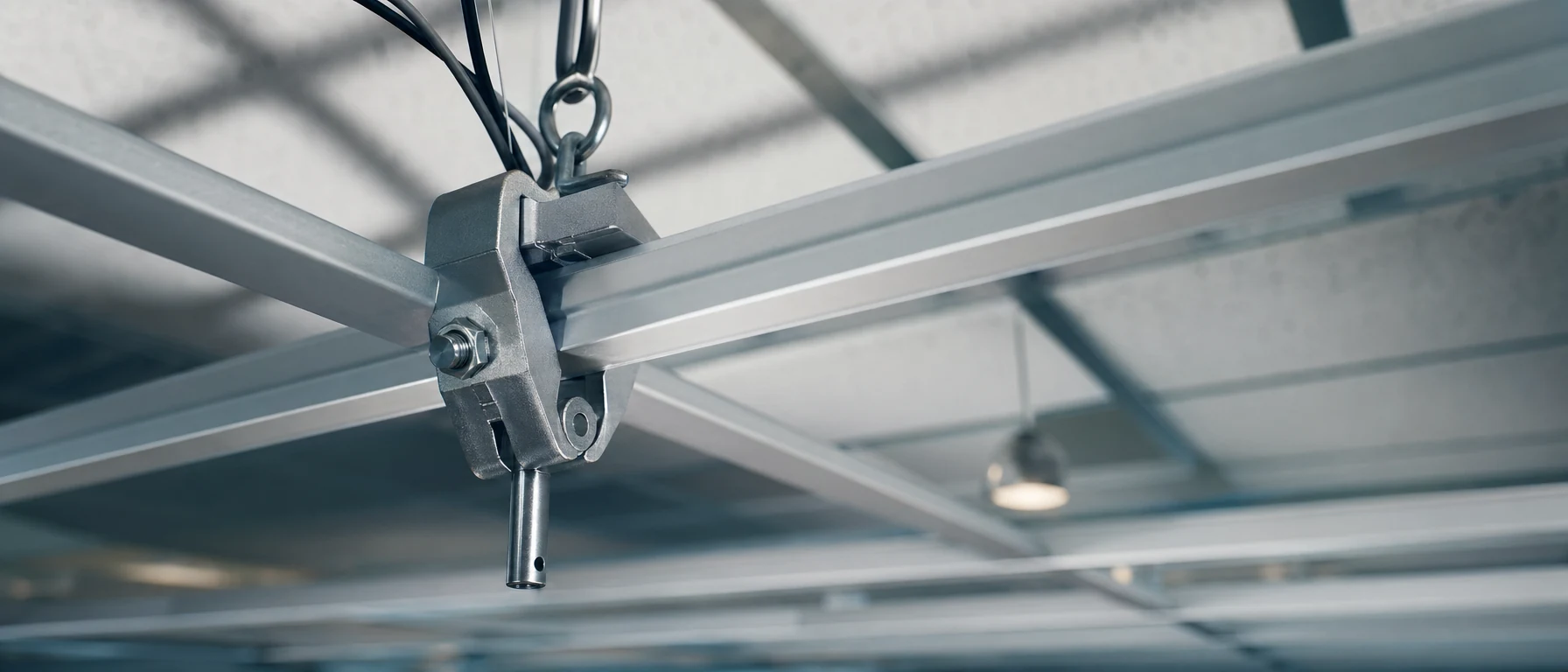
Drop Ceiling Scissor: A telescopic clamping device used to mount lights to suspended ceilings without drilling.
Technical Details
Standard drop ceiling scissors feature a working platform of 2.4 x 1.2 meters with integrated power connection (32A CEE) and DMX cabling. The hydraulic drive operates at a working pressure of 210 bar and lifts the platform at a speed of 0.15 m/s. Modern variants like the Genie GS-3268 RT offer all-wheel steering with a turning radius of 2.29 meters. Special versions for film studios (Studio Scissor Lifts) have dampened hydraulic pumps with noise levels below 68 dB, as well as low-vibration positioning systems for precise light adjustment during ongoing shots.
History & Development
JLG Industries developed the first drop ceiling scissor for film purposes in 1979 for Pinewood Studios in England. The JLG 2646ES model revolutionized studio lighting, as heavy tungsten spotlights could be repositioned for the first time without complex rigging systems. In 1987, Genie Industries introduced the first electrically operated models, which enabled their use in enclosed studio halls without exhaust issues. Since 2003, manufacturers like Snorkel and Skyjack have offered GPS-assisted positioning systems that allow for exact re-approach to pre-programmed lighting positions.
Practical Application in Film
In "Gravity" (2013), cinematographers Emmanuel Lubezki and Tim Webber used over 20 drop ceiling scissors for the LED light boxes that created the space look for the astronauts' faces. The scissors allowed for millimeter-precise adjustments of the 4K LED panels during performance capture shots. In large studio halls like Bavaria Film Studios, drop ceiling scissors reduce lighting setup time by an average of 40%, as grips no longer have to push lights across truss systems. The disadvantage lies in limited mobility during shooting and a restricted working area directly beneath the platform.
Comparison & Alternatives
In contrast to fixed hanging systems (Motorized Hoists), drop ceiling scissors offer full mobility but only reach 70% of the maximum ceiling height of modern studio halls. Telescopic mast solutions like the Autopole or Matthews Mombo Combo achieve similar working heights with lower load capacity (max. 80kg). Modern cable cam systems are increasingly replacing drop ceiling scissors for dynamic lighting setups, while these remain indispensable for static setups and intensive lighting with HMI spotlights from 2.5 kW upwards.