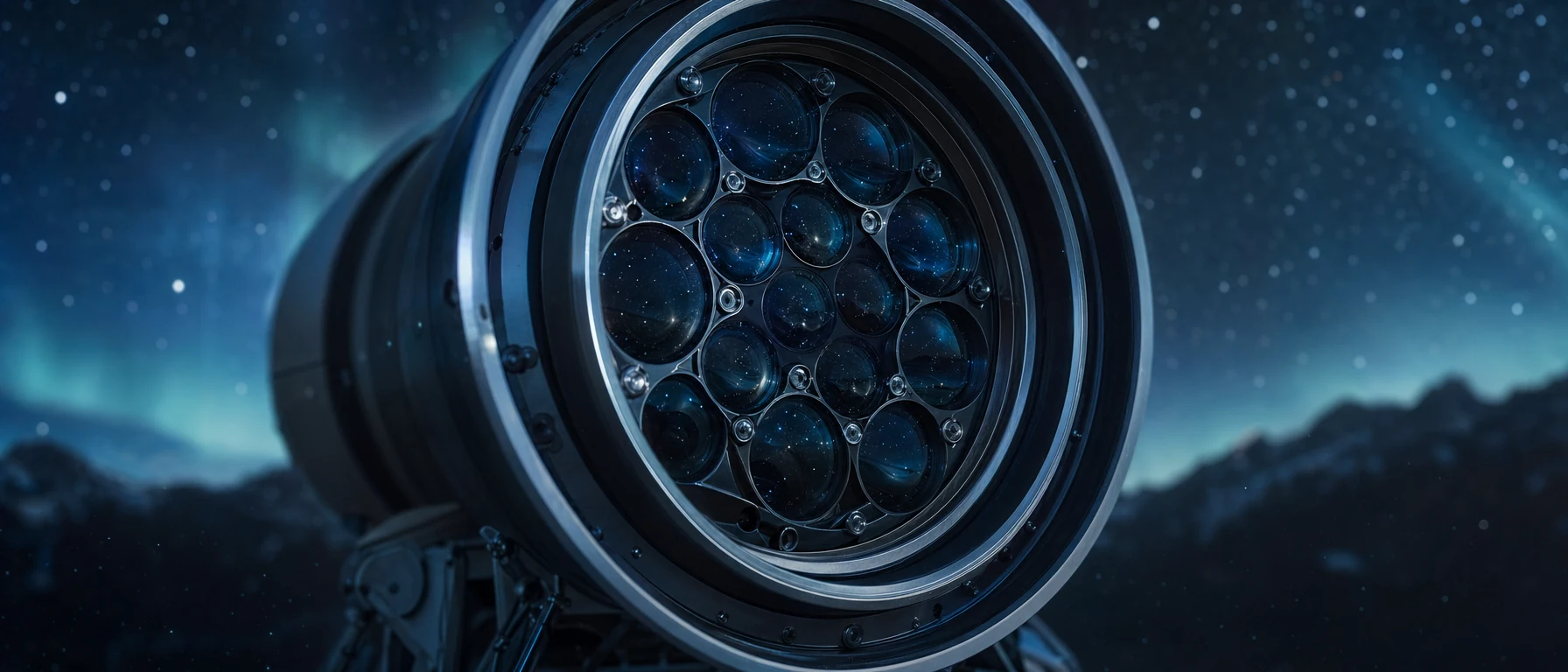
Celestron corrector for Schmidt-Cassegrain telescopes — converts f/10 to f/2 for extremely fast astrophotography with short exposure times.
Technical Details
The Hyper Star system is based on a four-element corrector mounted in place of the secondary mirror. On a 14-inch Schmidt-Cassegrain with an original f/11 (3910mm focal length), it creates an f/1.9 system with a 782mm focal length. The aperture is 355mm, resulting in exceptional light-gathering capability. The system fully corrects the image field up to a 28mm diameter, which corresponds to an APS-C sensor. The mechanical precision requires adjustment to within ±0.1mm.
History & Development
Starizona developed the first Hyper Star system in 2006 for Celestron Schmidt-Cassegrains for deep-sky photography. The film industry first discovered the system in 2012 for night shots with minimal light exposure. In 2015, Panavision adapted the concept for their Ultra Vista series, while RED presented a specially modified version for their cameras in 2018. Modern Hyper Star systems now achieve f/1.6 with simultaneously improved image quality towards the edges.
Practical Application in Film
Christopher Nolan used modified Hyper Star optics for the space sequences in "Interstellar" (2014) to capture real star fields without post-processing. "Blade Runner 2049" (2017) utilized the system for night exterior shots in Las Vegas, allowing practical lighting to be reduced to a minimum. The workflow requires precise focusing, as even the slightest deviations become visible at f/1.9. Disadvantages include extreme vignetting with improper calibration and the need for special filter adapters.
Comparison & Alternatives
Hyper Star differs from conventional wide-angle lenses through its combination of extreme speed and practically infinite depth of field from 10 meters onwards. Modern alternatives include Zeiss Supreme Primes with f/1.5 or Angenieux Optimo Ultra Compact zooms, which, however, offer significantly lower light output. For astro-photography, Hyper Star remains unrivaled, while for narrative filmmaking, the limited depth of field control is often problematic. ARRI Signature Primes offer more creative flexibility at f/1.8 with only slightly inferior low-light performance.