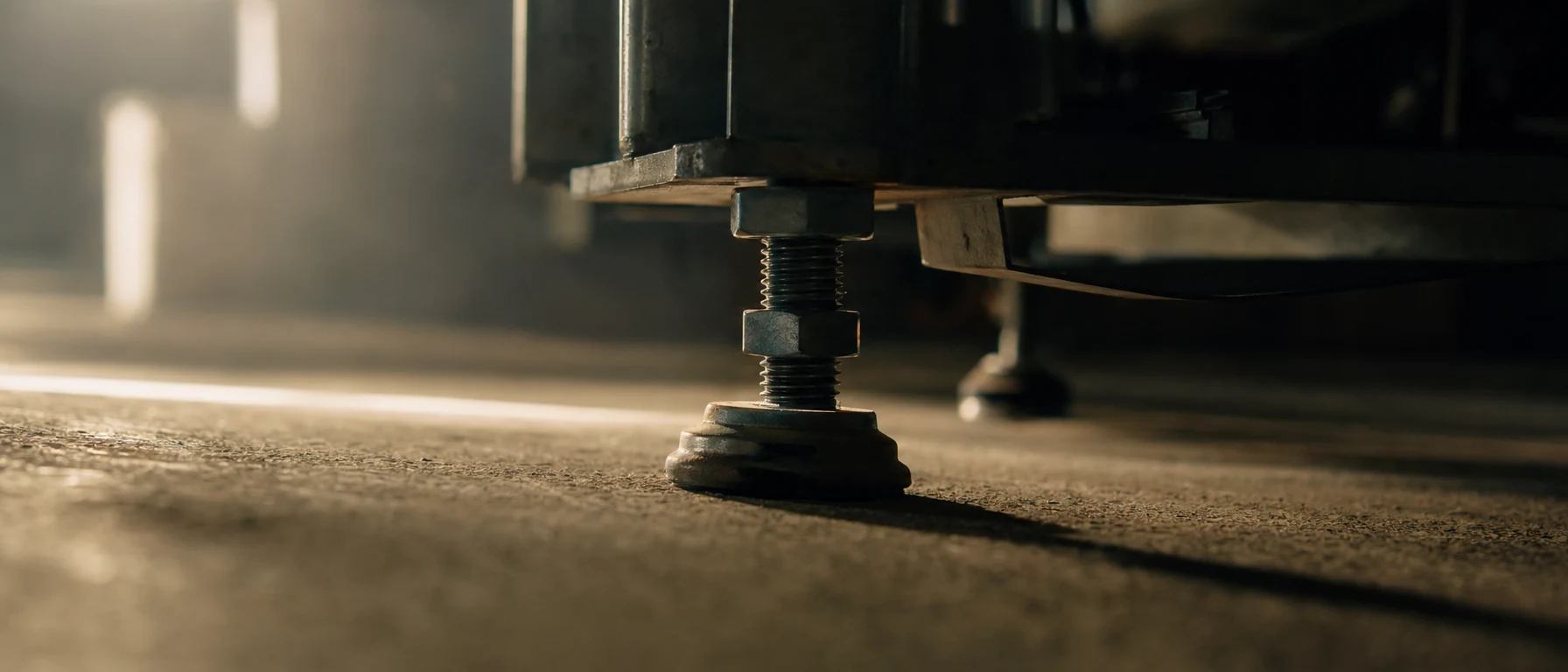
Adjustable tripod leg with screw mechanism for precisely leveling a stand or tripod on uneven ground.
Technical Details
Modern leveling legs are made of anodized aluminum or carbon and feature a threaded spindle with a 1.5 mm pitch for fine adjustment. The integrated spirit level (bubble level) has a sensitivity of 0.1° and a diameter of 20-25 mm. Hydraulic variants allow for stepless height adjustment via gas pressure springs with adjustment speeds of 2-8 cm/second. Three main types dominate: mechanical spindle leveling legs (budget segment), pneumatic systems (mid-range), and hydraulic versions with damping (high-end). The contact surfaces are usually equipped with rubber feet or spikes for different surfaces.
History & Development
Mole-Richardson introduced the first commercial leveling leg for film lights in 1958, after cinematographer James Wong Howe criticized provisional height adjusters made of wooden wedges on "Sweet Smell of Success" (1957). Matthews Studio Equipment perfected the hydraulic system in 1963 with the "Mombo Combo" series. The breakthrough came in 1971 with Arri's "Level-Leg" system, which for the first time enabled precision adjustment below 0.5°. Since the 1990s, manufacturers like Manfrotto and Gitzo have integrated carbon technology for a 40% weight reduction with the same stability.
Practical Use in Film
On "Blade Runner 2049" (2017), DoP Roger Deakins used leveling legs for millimeter-accurate alignment of the ARRI SkyPanel S360 on the uneven soundstage floors of the replicant scenes. The hydraulic Matthews leveling legs allowed for height adjustments during shooting without lighting interruption. Standard workflow: roughly position the stand, extend three leveling legs evenly, level with the central bubble, mount the light. Advantage: 90% time saving compared to wedge support. Disadvantage: 2.5 kg extra weight per stand and 15% higher acquisition cost.
Comparison & Alternatives
Leveling legs differ from standard tripod legs by their integrated spirit level and adjustment mechanism, while dolly wheels only offer mobility. Hi-hat tripods achieve similar low positioning but lack level adjustment. Modern alternatives include self-leveling gimbal heads and motorized pan-tilt heads with automatic horizoning. Leveling legs remain standard for static lighting setups, while motorized systems dominate for moving camera positions. Rule of thumb: use leveling legs on locations with ground unevenness exceeding 5°, standard equipment on flat studio floors.