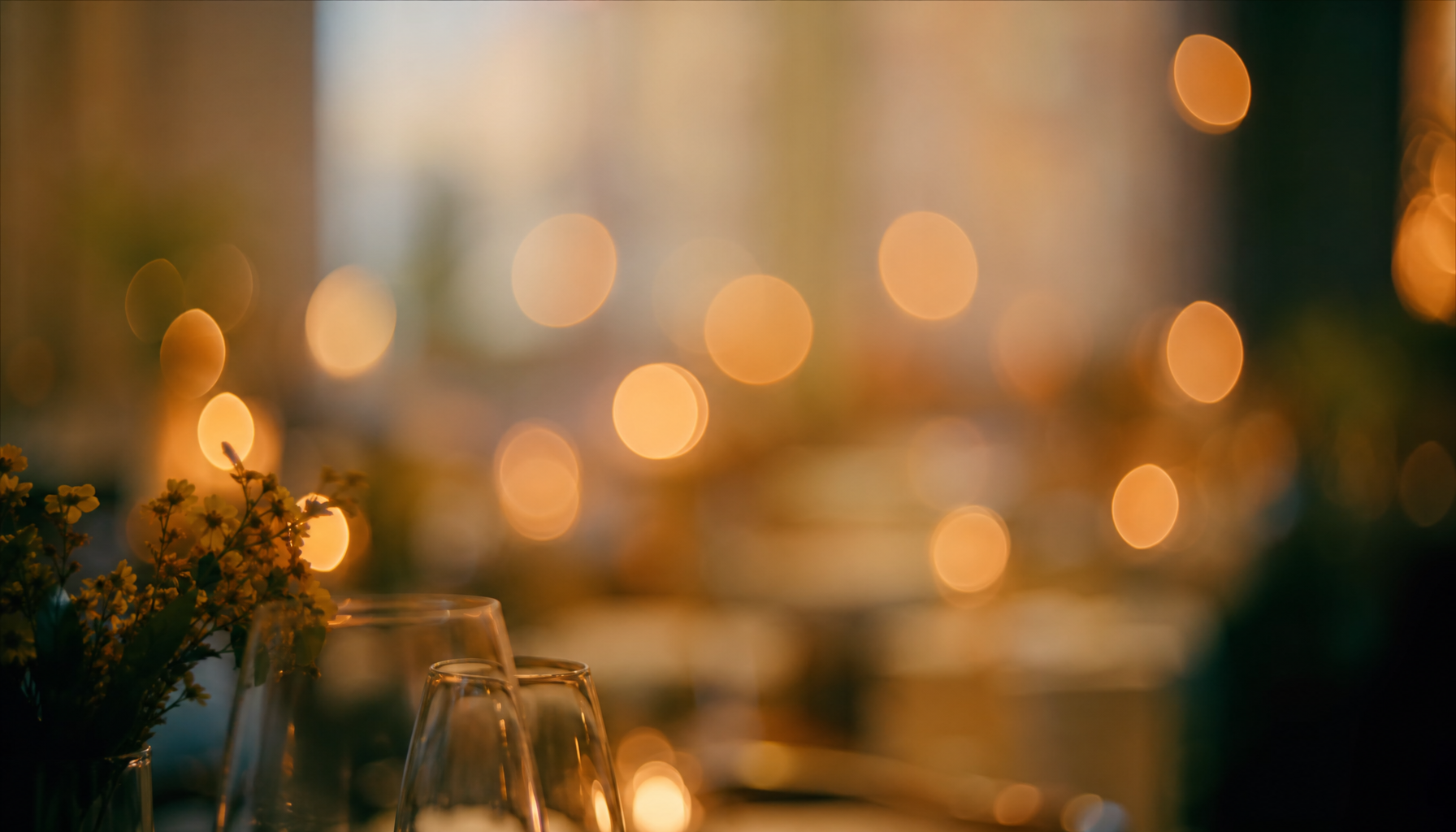
Elliptically distorted out-of-focus circles produced by anamorphic lenses or oval apertures. Characteristic of CinemaScope glass.
Technical Details
Oval bokeh arises from complex pupil aberration in zoom lenses, where the exit pupil changes its shape depending on focal length and focus position. The effect is particularly pronounced at focal lengths between 70-200mm and apertures from f/2.8 to f/4. Internal focusing (IF) and the movement of multiple lens groups lead to an asymmetrical vignetting of the aperture. Cinema zoom lenses such as the Angenieux Optimo 24-290mm T2.8 or the Canon CN20x50 exhibit this characteristic particularly clearly at extreme focal length positions.
History & Development
Oval bokeh was first documented in 1963 in early Angenieux zoom lenses for 35mm film cameras. The effect intensified with the introduction of more complex zoom constructions in the 1970s. The development of ENG (Electronic News Gathering) cameras in the 1980s led to more compact zoom designs with even more pronounced oval characteristics. Modern cinema zooms since 2010 minimize the effect through elaborate optical corrections and aspherical lens elements.
Practical Use in Film
Steven Spielberg's "Minority Report" (2002) deliberately utilized the oval bokeh of Panavision zoom lenses for its futuristic city scenes. The characteristic distortion supported the technological aesthetic. In "The Social Network" (2010), Jeff Cronenweth specifically employed oval bokeh in the server room scenes to enhance the digital atmosphere. The effect is particularly suitable for night shots with many points of light and technical environments. It becomes problematic in classic portraits where circular highlights are desired.
Comparison & Alternatives
In contrast to prime lenses, which consistently produce circular highlights, zoom lenses vary the bokeh shape depending on the focal length. Anamorphic lenses produce horizontally stretched, oval highlights through their 2:1 compression. Master Prime lenses from Zeiss or Cooke S4/i primes deliver consistently circular highlights. For critical beauty shots, prime lenses are preferred, while zoom lenses with oval bokeh are accepted for dynamic action scenes and documentary work.