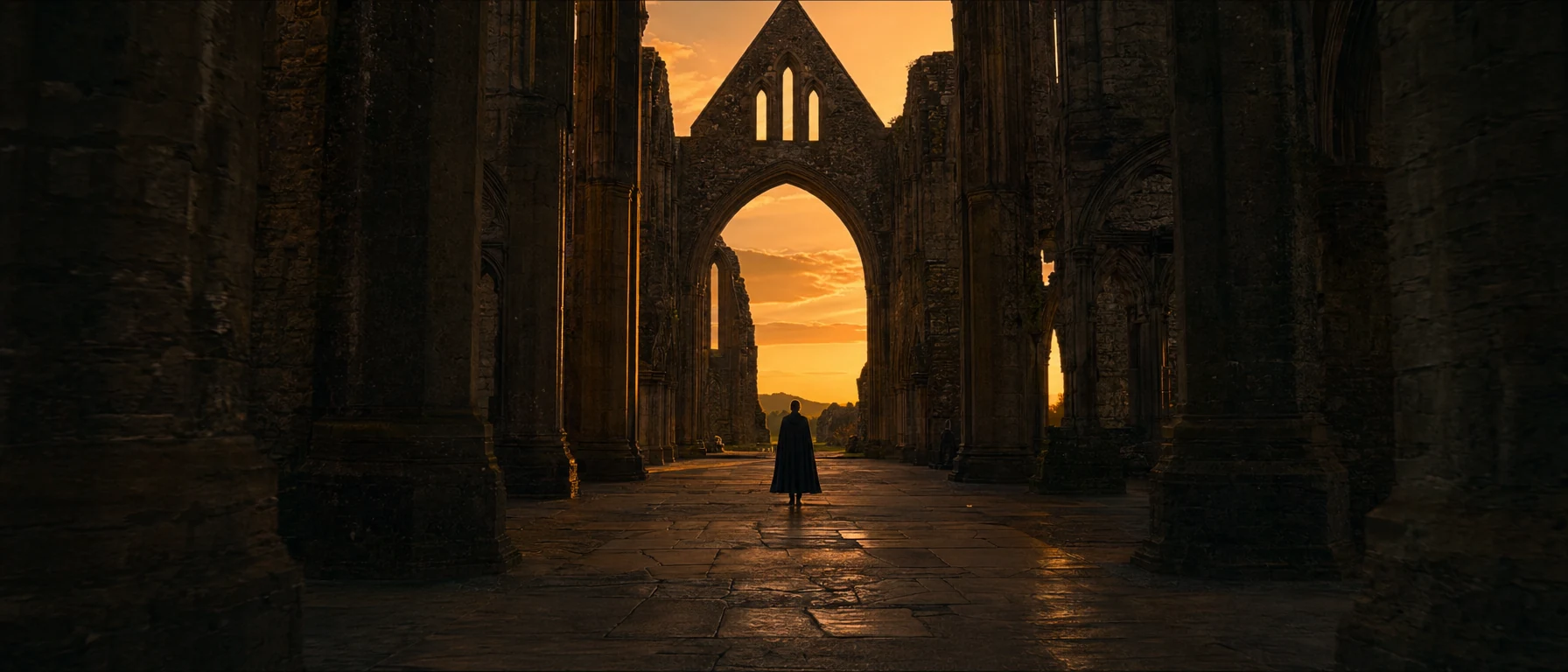
Camera movement pulling away from the subject, widening the frame to reveal more of the surrounding environment.
Technical Details
Pull backs are typically realized with dollies on tracks, Steadicam systems, or motorized camera cranes. Typical speeds range from 0.3 to 2.4 meters per second, depending on the desired dramatic effect. For track shots, 19mm pipes with standard track gauges of 60cm or 100cm are usually used. Modern gimbal systems enable pull backs with backward speeds up to 15 km/h while maintaining stabilization accuracy of ±0.02°. Camera cranes achieve extension lengths of up to 50 meters for vertical pull backs.
History & Development
The first documented pull back was filmed by Friedrich Wilhelm Murnau in 1924 in "The Last Laugh" using a camera car attached to ropes. David Wark Griffith perfected the technique in 1916 with mechanical track systems for "Intolerance." The breakthrough came in 1941 with Orson Welles' "Citizen Kane," where Gregg Toland combined pull backs with deep focus. Electronically controlled dolly systems became established from 1975 onwards, and computer-controlled motion control rigs since 1982 with "Blade Runner."
Practical Use in Film
Stanley Kubrick used a 12-meter pull back from the monolith in "2001: A Space Odyssey" (1968) to enhance its monumental effect. Martin Scorsese's famous Copacabana sequence in "Goodfellas" (1990) combines a pull back with Steadicam over a distance of 184 meters. Typical applications include establishing shots, building suspense through contextualization, and creating emotional distance from characters. The shot duration is usually 8-45 seconds at a constant speed.
Comparison & Alternatives
Pull backs differ from a zoom-out through perspective changes and natural depth staging. While zooms alter the focal length (typically 24-200mm), the camera position physically moves during pull backs. Crane shots expand the pull back with vertical components, and tracking shots with lateral movements. Digital pull backs are created in post-production through 2.5D compositing from high-resolution stills, but they do not achieve the natural parallax of mechanical moves.