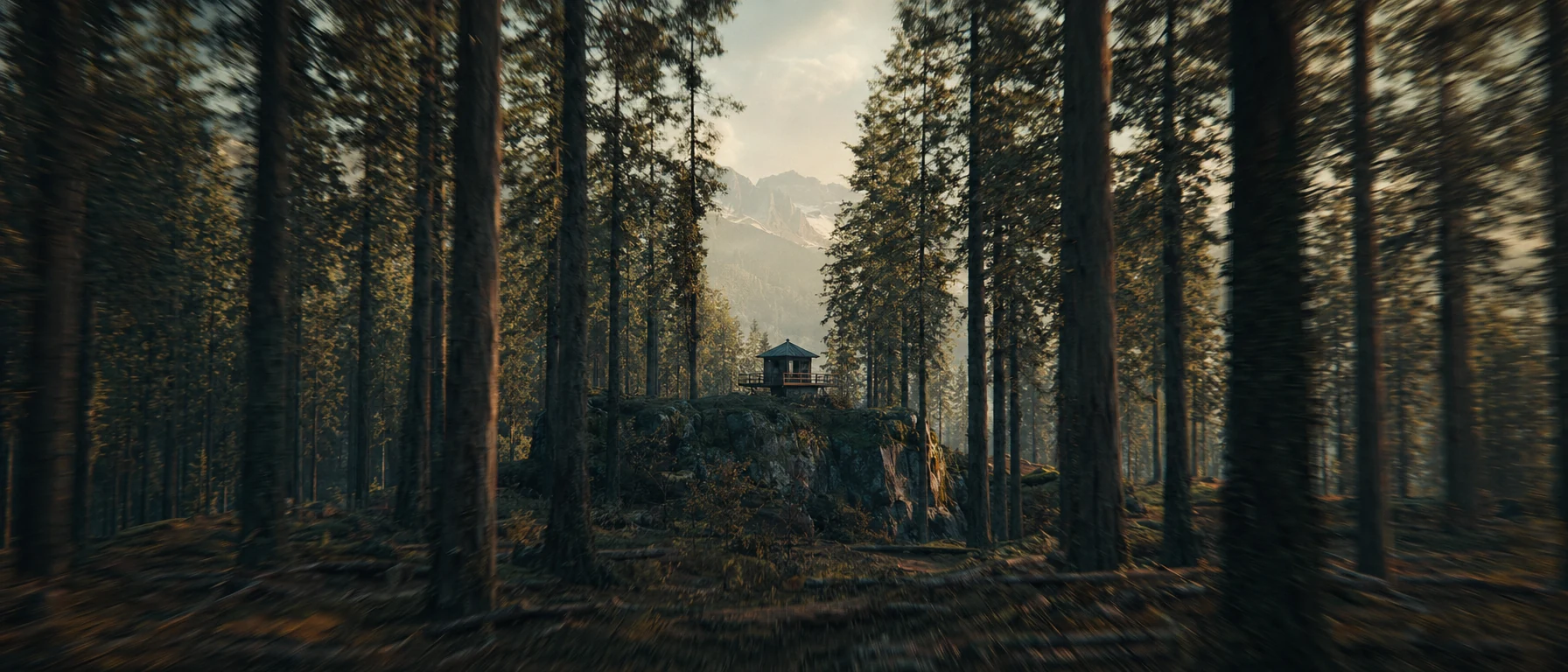
Camera movement away from the subject – physical distancing that reveals context, shows isolation or marks a conclusion. The counterpart to the forward move.
What is a Pull Out?
The Pull Out (German: Rückfahrt, also known as Dolly Out or Track Out) is a camera movement where the camera physically moves away from the subject. It reveals context and surroundings, shows isolation or abandonment, and often marks the conclusion of a scene or film.
Technical Definition
| Aspect | Details |
|---|---|
| Direction of Movement | Away from the subject |
| Perspective | Changes |
| Equipment | Dolly, Slider, Crane |
| Counterpart | Push In (Ranfahrt) |
Pull Out vs. Zoom Out
| Aspect | Pull Out | Zoom Out |
|---|---|---|
| Movement | Physical | Optical |
| Perspective | Changes | Stays the same |
| Depth Effect | Real, spatial | Compressed |
| Foreground | Disappears sideways | Only shrinks |
| Effect | Organic | Faster, harsher |
Effect of the Pull Out
Psychological Effects
| Effect | Description |
|---|---|
| Reveal | Showing context |
| Distance | Emotional removal |
| Isolation | Character's loneliness |
| Conclusion | Signaling an end |
| Surprise | Unexpected environment |
Narrative Functions
| Function | Application |
|---|---|
| Establishing | Showing location after a close-up |
| Scene End | Visual punctuation |
| Film End | Classic conclusion |
| Twist | Surprising revelation |
| Contextualization | Character within environment |
Classic Applications
The "Reveal" Pull Out
- Starts tight on a detail
- Slowly pulls back
- Reveals unexpected context
- Surprise effect
The "Isolation" Pull Out
- Starts on the character
- Continuously pulls back
- Character gets smaller and smaller
- Environment dominates
The "End" Pull Out
- Scene/film concludes
- Camera pulls back
- Characters/location are abandoned
- Emotional closure
Significant Film Examples
| Film | Scene | Effect |
|---|---|---|
| The Shawshank Redemption | Finale | Showing liberation |
| Gone with the Wind | Atlanta | Revealing chaos |
| The Truman Show | Finale | Truman leaves |
| Schindler's List | End | Time jump |
| 12 Angry Men | Conclusion | Leaving the room |
Equipment and Technique
Pull Out Systems
| System | Range | Application |
|---|---|---|
| Slider | 60–120 cm | Subtle |
| Dolly | Unlimited | Standard |
| Crane | Vertical + back | Epic |
| Drone | Outdoor, wide | Establishing |
| Steadicam | Dynamic | With movement |
Technical Challenges
| Challenge | Solution |
|---|---|
| Focus | Pull focus with movement |
| Speed | Maintain consistency |
| Foreground | Conscious planning |
| Endpoint | Clearly define |
Combinations
With Other Techniques
| Combination | Effect |
|---|---|
| + Crane shot up | Epic conclusion |
| + Slow Motion | Emotional stretching |
| + Music Fade | Audiovisual punctuation |
| + Light Dimming | Mood ending |
The Dolly Zoom (Inverse)
| Element | Details |
|---|---|
| Principle | Pull Out + Zoom In |
| Inventor | Hitchcock |
| Effect | Background "comes closer" |
| Application | Disorientation |
Emotional Meanings
| Type of Movement | Emotion |
|---|---|
| Slow, continuous | Melancholy, farewell |
| With crane shot up | Liberation, triumph |
| Fast | Shock, surprise |
| To wide shot | Isolation, loneliness |
Typical Patterns
Film Endings
| Pattern | Examples |
|---|---|
| Character walks away | Pull out continues |
| Camera pulls back | Character shrinks |
| Ascent + Pull Out | Epic conclusion |
| Fade during Pull Out | Gentle ending |
Scene Transitions
| Transition | Application |
|---|---|
| To Wide Shot | Initiating establishing shot |
| With Cut | Starting a new scene |
| With Dissolve | Time jump |
The Legacy
In Film History
- Classic Hollywood stylistic device
- "Pull back to reveal" as a convention
- Standard for film endings
Influence
The Pull Out is the visual equivalent of a book chapter ending – it marks conclusions and transitions.
Today
| Aspect | Details |
|---|---|
| Frequency | Very common |
| Equipment | Slider, Dolly, Crane, Drone |
| Cost | Variable |
| Trend | Combined with drones for epic reveals |
More in the lexikon