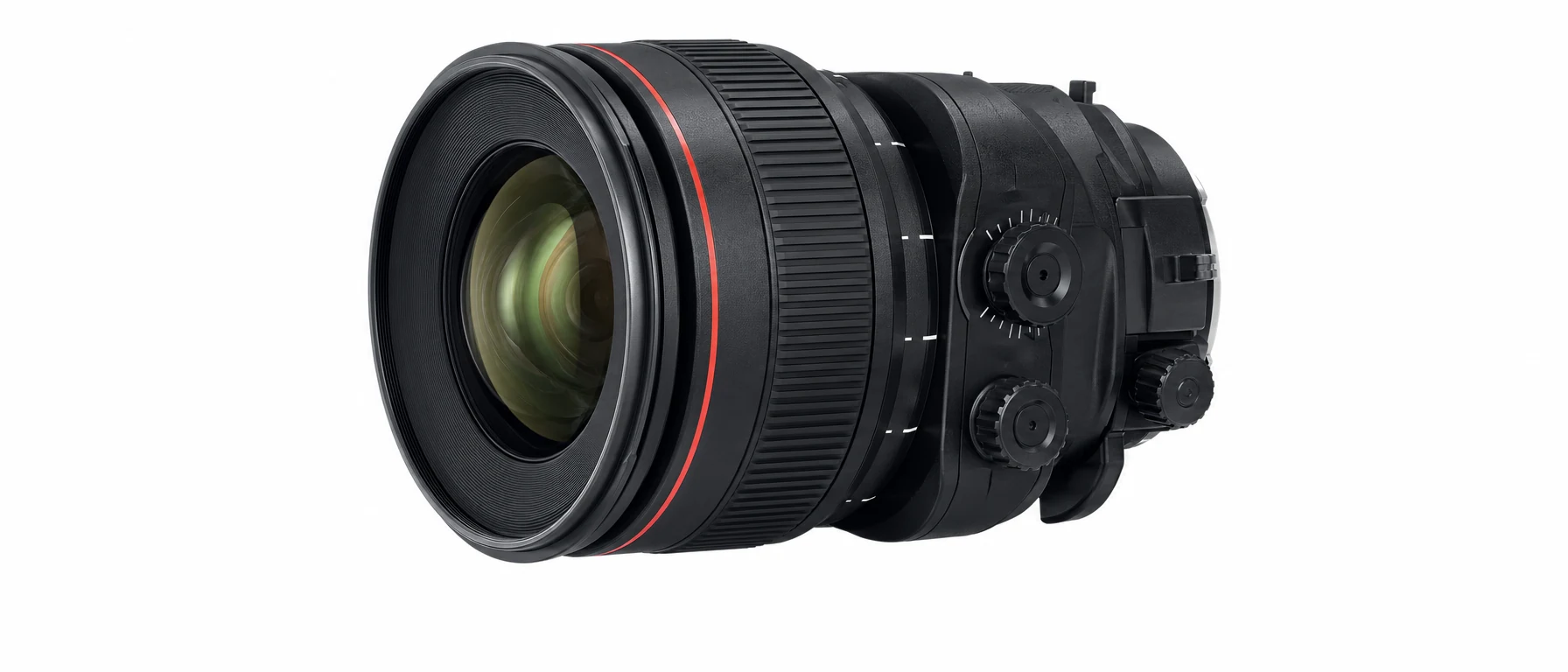
Specialty lens with tiltable and shiftable front element. Corrects perspective distortion and creates selective focus planes.
Technical Details
Modern tilt-shift lenses typically offer focal lengths between 17mm and 135mm with maximum apertures ranging from f/2.8 to f/4. The tilt function alters the plane of focus according to the Scheimpflug principle, extending the depth of field by a factor of 2.5 at a 4° tilt. The shift mechanism compensates for converging verticals with an image circle of at least 58mm in diameter – significantly larger than the 43.3mm of a full-frame sensor. High-quality models like the Canon TS-E 24mm f/3.5L II feature separate rotating mounts for tilt and shift, as well as 90° rotation of the entire mechanism.
History & Development
Canon introduced the first tilt-shift lens for SLR cameras in 1973, the TS 35mm f/2.8. Nikon followed in 1981 with the PC-Nikkor series (Perspective Control). The digital revolution from 2000 onwards increased demand, as sensors, unlike film, do not allow for post-correction of mechanical effects. In 2008, Canon established professional standards with its L-series, while Nikon countered in 2018 with manual PC-E lenses. Samyang and other third-party manufacturers democratized the market from 2015 onwards with affordable manual variants.
Practical Use in Film
Christopher Nolan used tilt-shift lenses in "Inception" (2010) for the dream sequences to create surreal miniature effects through selective focus. For architectural shots, the shift function corrects converging verticals without changing the camera's position – essential for symmetrical compositions. The tilt function enables extreme depth-of-field effects: complete sharpness at f/16 and 6° tilt, or isolated sharp bands for dramatic focusing. In terms of workflow, these lenses require precise manual operation and longer setup times.
Comparison & Alternatives
Unlike standard lenses, the image height remains constant when correcting converging verticals with tilt-shift lenses. Digital post-production tools like DaVinci Resolve offer similar corrections but reduce resolution by 15-30%. Modern cinema cameras with large-format sensors (Alexa LF, RED Monstro) expand the usable image circle and enhance tilt-shift effects. Anamorphic lenses create similar optical singularities but focus on bokeh characteristics rather than geometric control. Focus pulling systems like Preston FIZ can motorize tilt movements but remain more expensive than manual operation.