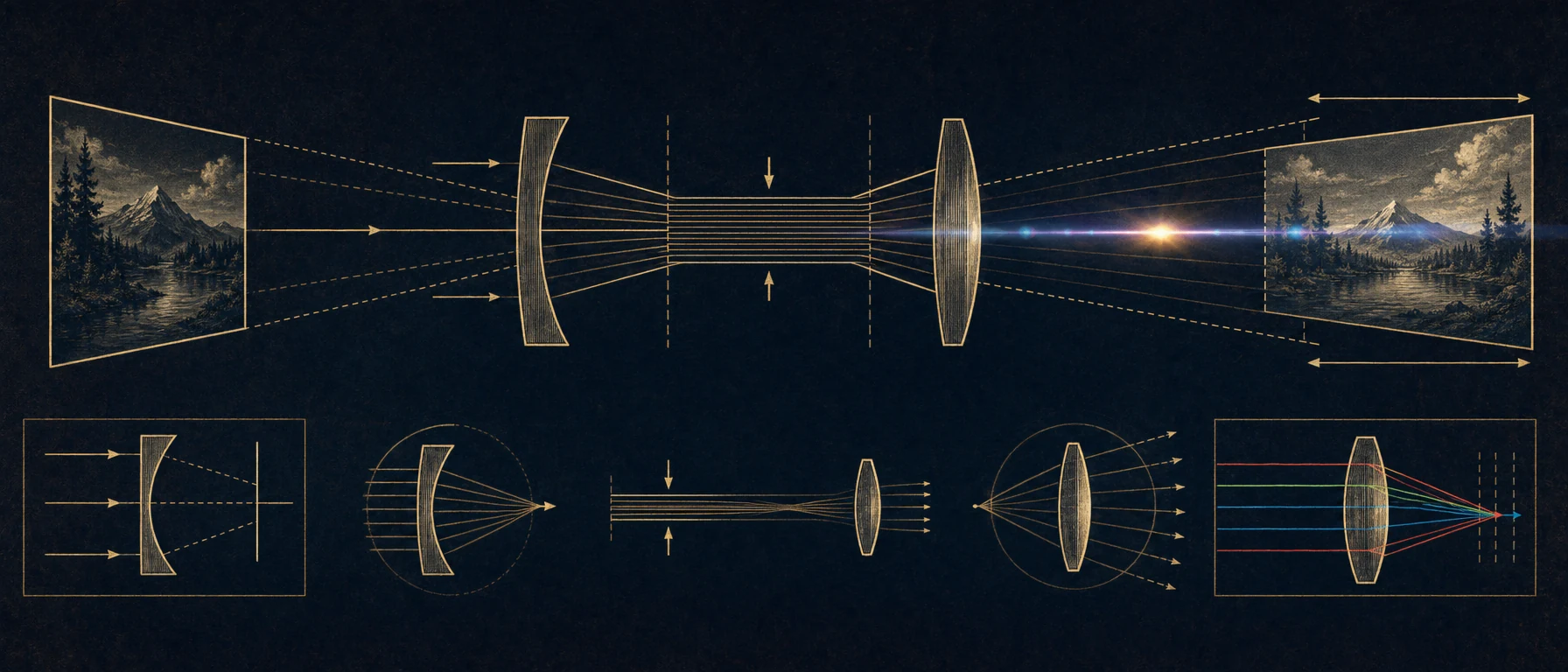
Optical accessory converting spherical lenses to anamorphic format producing distinctive stretched bokeh and flare characteristic of anamorphic cinema.
Technical Details
Modern anamorphic adapters work with a two-lens system of cylindrical glass lenses that exclusively influence the horizontal image axis. Standard adapters compress the image by a factor of 1.33x, while 2x adapters produce a stronger compression of 2:1. The adapters are manufactured in T-stops from T/1.3 to T/5.6 and require a minimum focusing distance between 0.9m and 1.2m. The additional weight varies between 1.2kg and 2.8kg depending on the manufacturer. The optical design leads to characteristic horizontal lens flares, increased chromatic aberration, and an asymmetry in depth of field between the horizontal and vertical planes.
History & Development
Henri Chrétien originally developed the Hypergonar lens system in 1926 for military purposes for panoramic surveillance. 20th Century Fox acquired the rights in 1952 and introduced the system as CinemaScope with the film "The Robe" (1953). Panavision perfected the technology from 1957 onwards with the Ultra Panavision series and dominated the market for decades. Since 2010, anamorphic optics have experienced a renaissance through manufacturers like Atlas Lens Co., Cooke, and ARRI, as they are more cost-effective than native anamorphic lenses and optimally utilize digital sensors.
Practical Application in Film
Christopher Nolan used Panavision anamorphic adapters for "Dunkirk" (2017) to achieve the widescreen format while maintaining flexibility with various focal lengths. Denis Villeneuve employed ARRI Master Anamorphic adapters in "Blade Runner 2049" (2017) to enhance the characteristic horizontal streaks in night scenes. The workflow requires precise calibration of focus systems, as the asymmetrical depth of field complicates manual tracking. Adapters offer a 60-70% cost saving compared to native anamorphic lenses with 85% of the optical quality.
Comparison & Alternatives
Anamorphic adapters differ from native anamorphic lenses in their lower optical precision but higher flexibility in lens changes. Modern alternatives include digital cropping with subsequent scaling or specialized sensors like the ARRI ALEXA 65 with 6K resolution. Adapters are suitable for productions with limited budgets or frequent focal length changes, while native anamorphic optics remain superior for high-end productions with controlled lighting conditions.