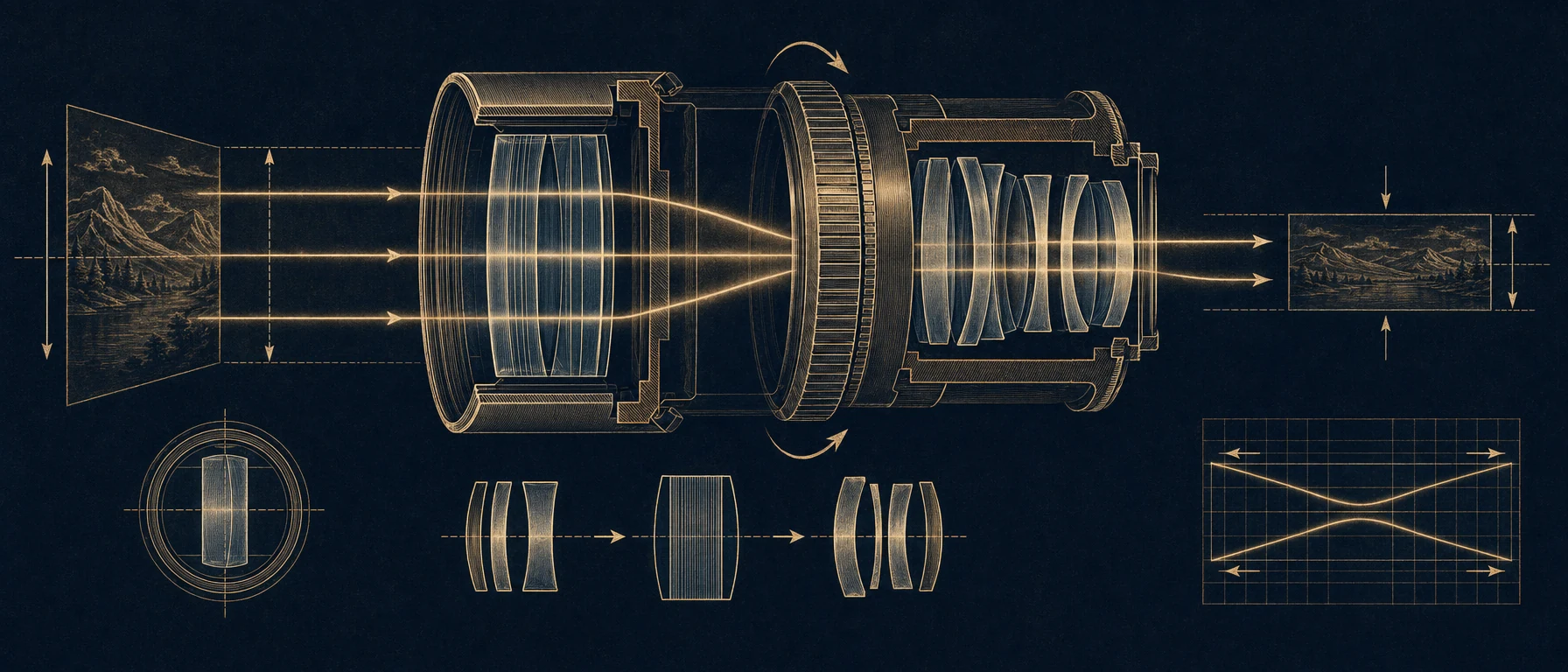
Anamorphic lens with a single focus ring instead of separate near and far focus controls — greatly simplifies operation on set.
Technical Details
Single-focus anamorphics operate with an integrated compensation mechanism that automates the mechanical coupling between focus and anamorphic settings. Typical focal lengths range from 25mm to 200mm, with apertures usually between T2.8 and T4. Horizontal compression is achieved via cylindrical lens elements with a factor of 2:1, while the vertical image plane remains unchanged. Modern single-focus systems achieve resolutions exceeding 6K with minimal chromatic aberration.
History & Development
Panavision developed the first single-focus anamorphics in 1958 as a response to the cumbersome handling of Henri Chrétien's original Hypergonar systems. In 1962, Todd-AO introduced the first fully integrated single-focus lenses with the 35 series. In 1999, Zeiss revolutionized the market with its Master Anamorphic lenses, which for the first time offered a consistent T1.9 aperture with single-focus functionality. Starting in 2016, Atlas Lens Co. established a new generation of affordable single-focus anamorphics for independent productions with its Orion lenses.
Practical Use in Film
Roger Deakins used Arri Master Anamorphic 40mm and 75mm single-focus lenses for "Blade Runner 2049" (2017) to achieve characteristic horizontal lens flares while maintaining precise focus. "Mad Max: Fury Road" (2015) consistently used Panavision G-Series single-focus lenses for rapid focus pulls during chase sequences. Single-focus systems reduce focusing time by approximately 40% compared to dual-focus setups and eliminate the risk of synchronization errors between the two focus planes.
Comparison & Alternatives
Dual-focus anamorphics require separate adjustment of the spherical base optics and the anamorphic attachment, but often offer higher optical quality at lower costs. Digital anamorphic simulation achieves the 2.39:1 look without optical distortion but sacrifices characteristic bokeh effects and lens flares. ARRI Signature Primes with a 2.39:1 sensor crop offer a similar visual impact with spherical optics, while Cooke Anamorphic/i lenses are considered a modern single-focus alternative to Zeiss Master Anamorphics.