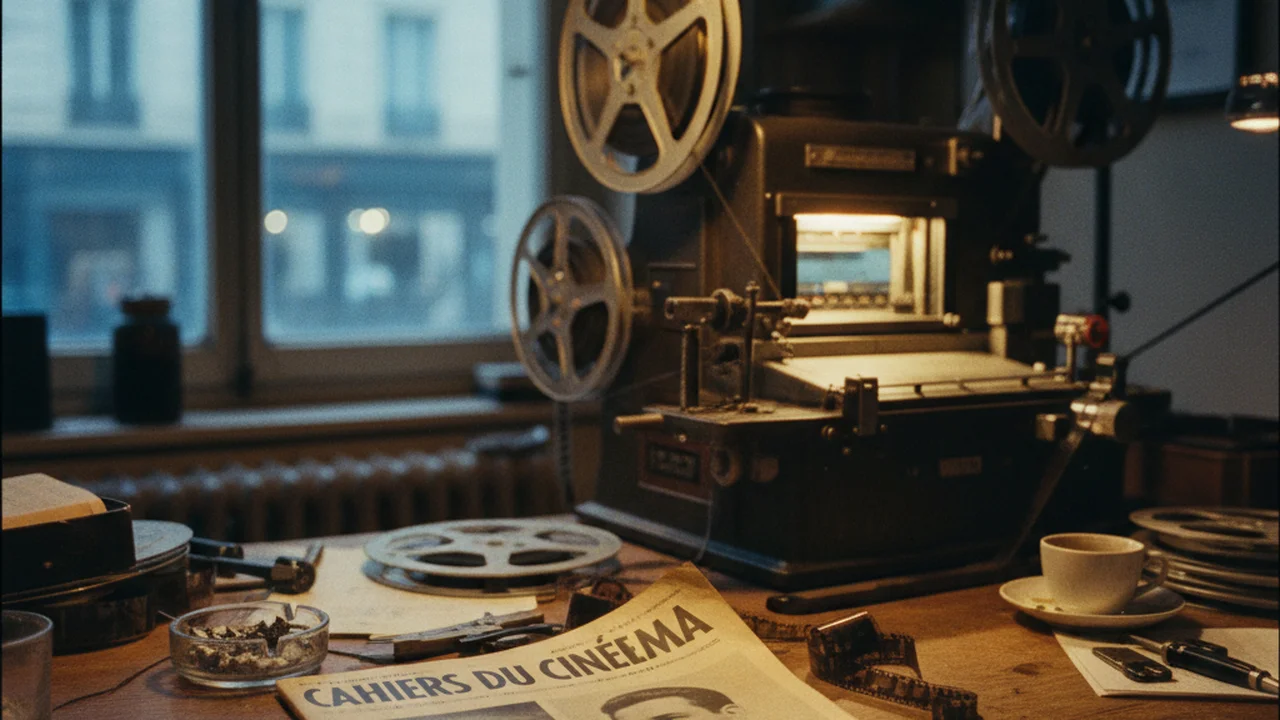
Film theory from the 1950s that identifies the director as the true author of a film — beyond script and studio. Originated with Truffaut in 1954, expanded by Sarris in 1962.
Auteur Theory shifts authorship in cinema from the screenplay and the studio to the director. It posits that a film has a single creator, and that is the person who enforces the vision—usually the director, but sometimes a producer (Selznick), a cinematographer (Vittorio Storaro), or an editor (Walter Murch).
Origin — Truffaut 1954
François Truffaut, then a 21-year-old critic for Cahiers du cinéma, published the essay "Une certaine tendance du cinéma français" in 1954—a polemic against the clean studio tradition of French cinema. Truffaut's thesis: only filmmakers who understand screenplay and direction as a unity are auteurs. He contrasts the tradition de qualité (filmed theater, polished dialogue, anonymous studio craftsmen) with directors like Renoir, Bresson, Cocteau, Tati, and Ophüls, who have established a recognizable personal style across multiple films.
Sarris 1962 — Import to the USA
Andrew Sarris translated the concept into the US discourse in 1962 with "Notes on the Auteur Theory," proposing three criteria: technical competence, personal style, and a consistent "interior meaning" across works. Sarris then ranked Hollywood directors in a famous hierarchy—Hitchcock, Hawks, Ford, Welles at the top; Wyler, Wilder, Mankiewicz in the middle; many others as "less than meets the eye." This list ignited a war.
Kael 1963 — The Counter-Thesis
Pauline Kael responded in 1963 with "Circles and Squares," dismantling Auteur Theory as a romantic construct that ignores collaborative realities. Her main arguments: first, films are collective works in which the screenwriter, cinematographer, editor, and actors are equally carriers of style. Second, the auteur schema leads to overvaluing mediocre films by good directors simply because they fit the stylistic pattern. The debate has permanently polarized the field—and rather strengthened the theory than weakened it, as it was forced into a differentiated defense.
Expansion — DP-Auteurism, Producer-Auteurism
Later generations have extended the concept. Cinematographers like Vittorio Storaro, Roger Deakins, or Emmanuel Lubezki are now considered auteurs of their works—their visual language shapes films more recognizably than the respective director's. Producers like David O. Selznick (Gone with the Wind, Rebecca) or Megan Ellison (Annapurna Pictures) are considered producer-auteurs because they enforce a consistent line of work across projects. Editor-auteurism, represented by Walter Murch and Thelma Schoonmaker, focuses on the creative role of editing in the final vision.
Practical Implication Today
For modern filmmaking practice, Auteur Theory is less relevant as an analytical tool and more as a marketing logic. The streaming era has intensified the director brand: Netflix packages are sold with names like Cuarón, Scorsese, or Coppola, not screenwriters or casts. In the AI-cinema discourse, the question is resurfacing: if a model makes the majority of visual decisions, who is the author? The answer is currently shifting—early AI auteurs like Bria Kessler or Dave Clark are being labeled as such in the industry, even though the term is not yet consolidated for this purpose.